Tuesday, 24 March 2015

what I know about Maya

THE GRID

Maya Grid

This is a main view of the grid in Maya showing all 3 sides of the object or as known as perspective view. The 3 sides are known as front, side, and top in short x,y, and z.
4 different view showing all different sides
by simply pressing the space bar will bring you to a 4 separate view of the grid. Top left view is viewing the grid from the top(y), bottom left is side(z) and bottom right is front(x). The top right is the default view of the grid(perspective).
The Tools 
Image result for in maya basic tool
Basic tools
The basic tools in Maya are tools that all 3D modelers use and always use.  
These tools are :

Select tool - The most common tool in selecting objects, lines and such. You can also click and drag to select multiple objects.

Lasso tool - This tools is similar to select tool only it selects the objects that it is drawn on.

Tools from here on are based on the object
Move tool - The move tool allows you to move 3D objects in a perspective view as shown in the picture above. You can move the object freely by clicking on the middle(pivot point) or precisely with just the arrows.

Rotate tool - The rotate tool is used to rotate objects. The object can rotate in 3D just by clicking on and move with the respective colors.

Scale tool - Scale tool is commonly used to make objects bigger or smaller. Using this tool you can adjust an object's height, length and width how ever you wish.

Soft Modification tool - This tool allows simple changes to an object.

Show Manipulator tool - Shows the manipulator so that you can adjust the construction history.


The polygon tool
The polygon tool is the most common and basic tools used to create objects. It consist of basic objects like cube, pyramid, cone and such. The tool is commonly used as a basic building block to create simple objects.
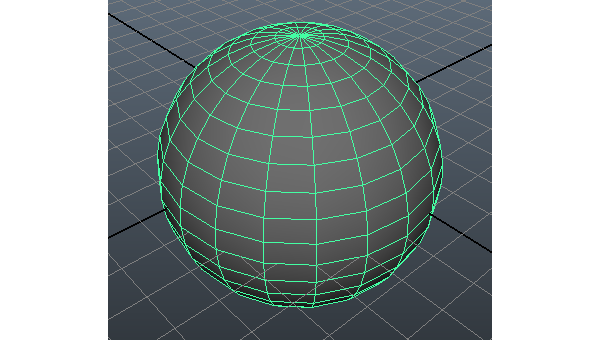
Objects created using the polygon tool is called Polygon geometry. It is a three-four sided plane of geometry that makes a face of an object


The Surface tool

The Surface tool is similar to the polygon tool but the difference is that the surface tool creates NURBS which that for non-uniform rational b-spline. NURBS are commonly used for very smooth objects because they don't require as many points to create the same look as polygon geometry would. 


NURB splines are curves used to create smooth, minimal surfaces and geometry. The surface of a NURBS always have four sides that are defined by control points.


The Subdivision tool

The subdivision tool are a combination of both polygon and surfaces(NURBS). It is sometimes refered as NURMS or non- uniform rational mesh smooth.


Subdivision surfaces use an algorithm to take polygon geometry and smooth it automatically


Extrude

Extruding is one of the primary ways of creating additional geometry on a mesh. It aloows you to pull out extra geometry from a face,edge or vertex.

Beveling

Beveling is the process of chamfering, or creating rounded edges on a mesh. Beveling expands each vertex and edge into a new face. Beveling helps to lose some of the computer generated look that comes with 3D modeling.

RENDERING

Every result you see in the scene view is displayed using the computers's graphics hardware. All textures and shadings are displayed quickly but in low quality. In order to view the results in a higher and more realistic quality we must use a process called software rendering.

Software rendering can take up to seconds or minutes depending on the complexity, geometry, shades, lighting and other visual elements present in a scene.

The most common type of Renderers :

Maya software renderer
Renderer with broad capabilities. Able to produce high-quality images with complex shading networks, including textures and ramps. Software rendering is computed through the processor.

Mental ray
Renderer that includes exclusive, advanced rendering functionality, such as host and network parallel rendering, area light sources for soft shadows, global illumination, and light patterns.

Maya hardware renderer
Renderer that uses your machine’s graphics card for computation. You can produce broadcast resolution images in less time than with software rendering, and in some cases, the quality may be good enough for final delivery.

Monday, 23 March 2015

Cubism(20th cen)


Cubism was one of the most influential visual art styles of the early twentieth century. It was created by Pablo Picasso and Georges Braque in Paris between 1907 and 1914. 

Analytic Cubism staged modern art's most radical break with traditional models of representation. It abandoned perspective, which artists had used to order space since the Renaissance. And it turned away from the realistic modeling of figures and towards a system of representing bodies in space that employed small, tilted planes, set in a shallow space.

Synthetic Cubism proved equally important and influential for later artists. Instead of relying on depicted shapes and forms to represent objects, Picasso and Braque began to explore the use of foreign objects as abstract signs.

Cubism paved the way for geometric abstract art by putting an entirely new emphasis on the unity between the depicted scene in a picture, and the surface of the canvas.


This is a video of my cubism project

This project shows the daily life of a tree which is taken from evening to night. Every 30 minits a picture is taken to create a cubism form the tree.

Surrealism (20th cen)


Surrealism is a cultural movement that began in the 1920s. It best known for its visual artworks and writings. Artists painted unnerving, illogical scenes with photographic precision, created strange creatures from everyday objects and developed painting techniques that allowed the unconscious to express itself , an idea or concept.
Surrealist works feature the element of surprise and the unexpected. Surrealist artists and writers regard their work as an expression of the philosophical movement first and foremost, with the works being an artifact.
Surrealism developed out of the Dada activities during World War I and the most important center of the movement was Paris. From the 1920s onward, the movement spread around the globe, eventually affecting the visual arts, literature, film, and music of many countries and languages, as well as political thought and practice, philosophy, and social theory.

Storyline


                 The story starts when the Repchinese sent an ambassador to meet the Sultan of the Furmalays to discuss politics and peace. A Chinese messenger was first sent to inform of the ambassador’s arrival. Laksamana Jahat was one of the first to receive the message as he was in the charge of one of the frontline territory. He decided it is a perfect oppotunity to break the cease fire treaty

                 The next morning, back at the Furmalay’s capital city, some Laksamanas was called back to the capital, Jahat being one of them. They were being called back to tighten the security of the capital and the Sultan. At Around noon, the Repchinese ambassador along with a number of Repchinese guards arrived at the capital. The citizens of the capital were uneasy of their arrival, even when the guards of the capital kept close watch on them. As the Repchinese marched towards the sultan’s castle, Jahat was assessing the strength of the guards. The guards are of elite rank and with this amount of guards he is surely going to need someone to help him with his scheme.

                 Hang Rimau, who was one of the top laksamanas of the Furmalays was just patrolling outside the city. Hang Rimau is brave and loyal, but his weakness is that he puts a lot of trust in his friends. Jahat saw this chance to manipulate him into thinking that it was an assassination attempt on the Sultan at midnight. After being told of the attempt, Hang Rimau was curious on how did he know of such attempt and asked series of questions but Jahat, using his cunning mind answered them with convincing answers which has almost no arguable points. In the end, Hang Rimau agreed to work together to disrupt the plan Jahat then told him to wait for him by the castle entrance until he has come up with a plan.

                 It was almost night time, Hang Rimau waited patiently for Jahat’s return almost to the point of thinking that his friend had been caught until Jahat suddenly appeared behind him. Hang Rimau startled, but at the same time relieved to see him. Jahat apologized for scaring him and told him that the ambassador’s room was at the top guess room of the castle. He also told him that the security was very tight, but he is familiar with the castle’s layout and know of a secret passage to the ambassadors room. The plan was simple, Jahat will distract the guards while Hang Rimau takes the secret passage to the ambassadors room and kill him. Hang Rimau heard this and did not like the plan to kill but wanted to capture so the ambassador will admit his crimes. Jahat grunted for a moment, and agreed to capture instead. As Hang Rimau went ahead on the plan, Jahat gave an evil grind behind Hang Rimau and went to distract the guards.
                  
                     Hang Rimau proceeded stealthily as Jahat lured more and more guards away from Hang Rimau’s position. He finally reached the secret passage and entered it, the passage was quite narrow and dark which is hard to see where he is heading. Unknowingly, Hang Rimau tripped and fell breaking the entrance at the other end of the passage, into the ambassador’s room. Immediately, the ambassador grabbed his spear and gave a downward blow. With quick reflexes, Hang Rimau dodged the blow with a side roll. Hang Rimau got up at quickly drew his Kris and the two was locked in a dreadful combat. The battle took quite a while and Hang Rimau was victorious as he managed to knock the ambassador unconscious. Hang Rimau was absolutely tired from that battle when suddently the door flung open. There standing was a dark figure, it was Jahat with his Kris drawn and soaked with blood, his face with an evil expression. Jahat lunged at the unconscious ambassador, Hang Rimau knowing that he lied about his agreement stopped the blow in time. Hang Rimau tried to reason with Jahat but got no answer, instead Jahat attacked Hang Rimau instead. Hang Rimau was already weary fighting the ambassador, he was barely able to evade and block Jahats attacks. Hang Rimau fell as the last of his strength was used up, Jahat was about to land the final blow when luckily the Sultan and his guards arrived and stopped Jahat in time.

                         Hang Rimau told the Sultan of the assassination attempt but the sultan told Hang Rimau there was never such an attempt and said that they became good friends from previous political discussions. Hang Rimau was ashamed of his actions as he was tricked by Jahat. Jahat was bursting in rage as he is unable to kill the ambassador, he was chained and taken to prison as he has clearly lost his mind. Hang Rimau put down his Kris and kneel infront of the Sultan begging for forgiveness. Hang Rimau is sure that he will be stripped of his rank and sent to prison or executed. But, the sultan did not do so, he simply forgive Hang Rimau without consequences. Hang Rimau asked why and the sultan replied that Hang Rimau like a son to him and has never been disappointed in him. Hang Rimau shed a tear and promise that such mistake would never happen again.

                           In the end, Hang Rimau apologized to the ambassador as they return to the repchinese capital. Jahat was stripped of his rank and was sentenced to prison for the rest of his life. The Furmalays and Repchinese established peace a few months later and both sides prospered the everlasting peace.


Sunday, 22 March 2015

Genre


1st movie that I watched and to relate to my storyboard is Hansel & Gretel. From that movie I take the plot of witch hunting where the main character hunts a villain who is a necromancer that rises undead which contributes to zombies. Also, a bit of the main characters history being that the characters's parents was killed by the villain
The 2nd movie is resident evil  which where the main character and environment refers to. Where buildings are destroyed and zombies infest the area. I take some of the character skills in resident evil and import them to my character as a skillful character.

Wednesday, 18 March 2015

Intro to 3D

What is 3D (Three-Dimensional)

3D is something that has width, height and length, any object that has those 3 characteristics is considered 3D. Typically, the world that we live in is actually a 3D environment and we move around in 3D everyday.

We are able too see and perceive different spatial relationships between objects just by looking at them because we have 3D perception. As we look around our eyes create two-dimensional(2D) images of our surroundings and our brain processes them into 3D.

What we use to perceive 3D :

Stereoscopic vision: Our eyes see slightly separate images this causes closer objects appear more separated than distant ones.

Accommodation: When our eyes look at a close or far away object, the lens in our eyes changes shape showing how far or close the object is.

Parallax: As our head moves one side to another, closer objects appear to move more than distant ones.

Size familiarity: If you know the size of an object, you can tell approximately how far away it is based on how big it looks. Also, if you know that two objects are a similar size to each other but one appears larger than the other, you will assume the larger object is closer.

Aerial perspective: Because light is scattered randomly, distant objects appear blurry than nearby objects. 

Monday, 16 March 2015

Aesthetic (digital design)

This is my aesthetic work which shows our current life of living. This shows people are becoming lazy and depending more on technology to do their work. Which is the issue, that technology is becoming so powerful that we are like being controlled by them.